Improving Clarity, Confidence, and Decision-Making in the Checkout Experience
IKEA Heuristic Evaluation
Overview:
Tool(s) Used:

Full Report:
Scope of Work:
Team:
Year:
Duration:
PROBLEM
IKEA's U.S. e-commerce platform generated $1.9 billion in FY2025, accounting for roughly 36% of total sales. Despite 457 million+ annual online visits and a competitive conversion rate, the checkout experience introduces friction that can stall customers before they complete a purchase.
THE EVALUATION AT A GLANCE
What We Found
Our team, along with seven other usability experts evaluated the IKEA U.S. website using Nielsen's 10 Usability Heuristics, focusing on a realistic scenario: a student trying to purchase and schedule same-day pickup for a dinnerware set while moving into a new apartment.
The evaluation surfaced 16 usability issues, including one rated as a catastrophe, and led to three recommendations targeting IKEA's checkout flow.
THE PROBLEM
IKEA's Checkout Speaks Its Own Language, and Users Don't
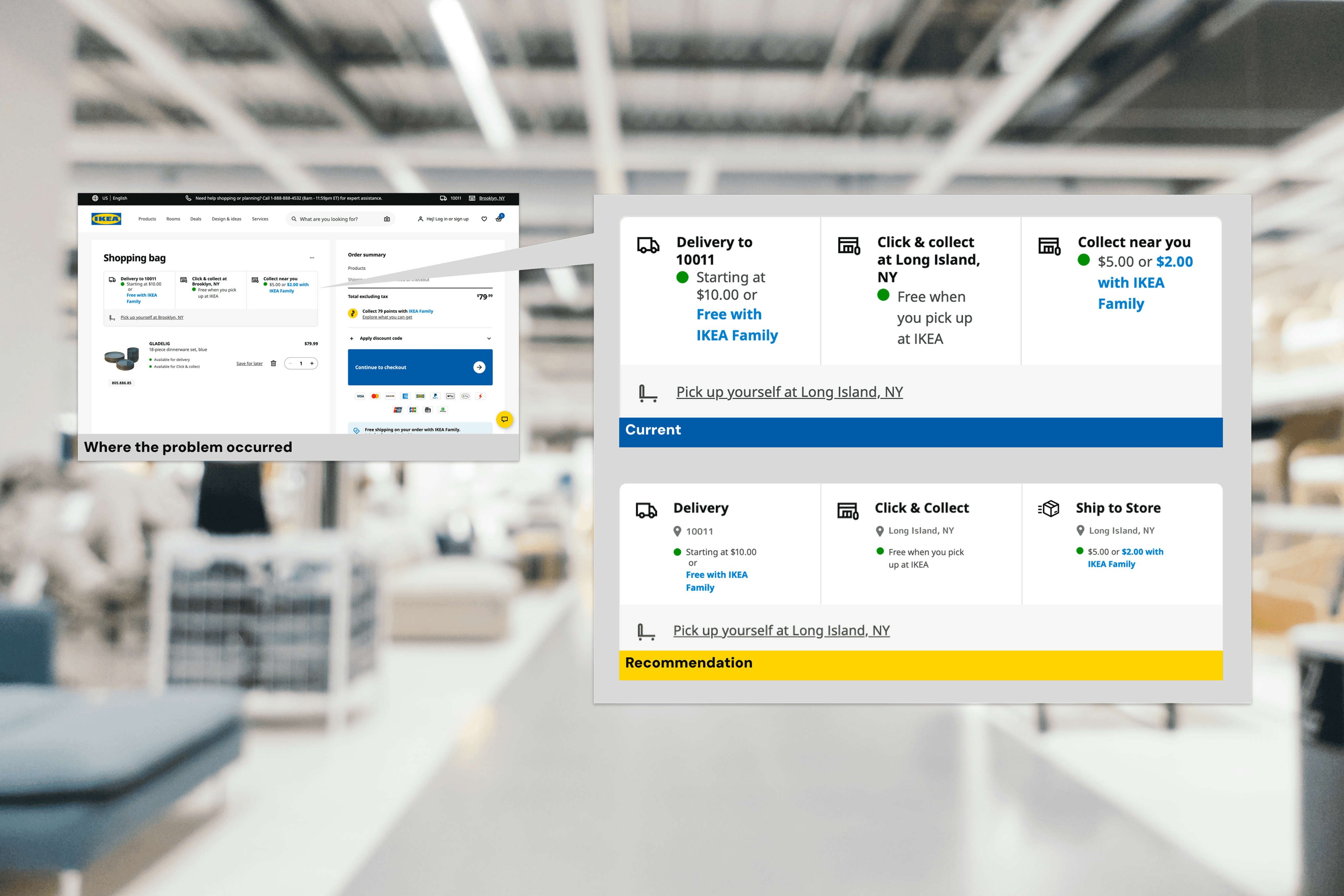
The core issue we identified was a critical "understanding gap" between IKEA's internal fulfillment logic and the mental models of everyday shoppers. IKEA presents multiple fulfillment methods at checkout, "Delivery to 10011," "Click & collect at Brooklyn, NY," and "Collect near you," but the overlapping language and identical icons make the distinctions between them unclear.
Users may reasonably interpret "Click & Collect" and "Collect near you" as describing the same action: picking up an item at a store. A separate "Pick up yourself" link appears below these options, introducing yet another pickup-related term without clarifying how it relates to the options above.
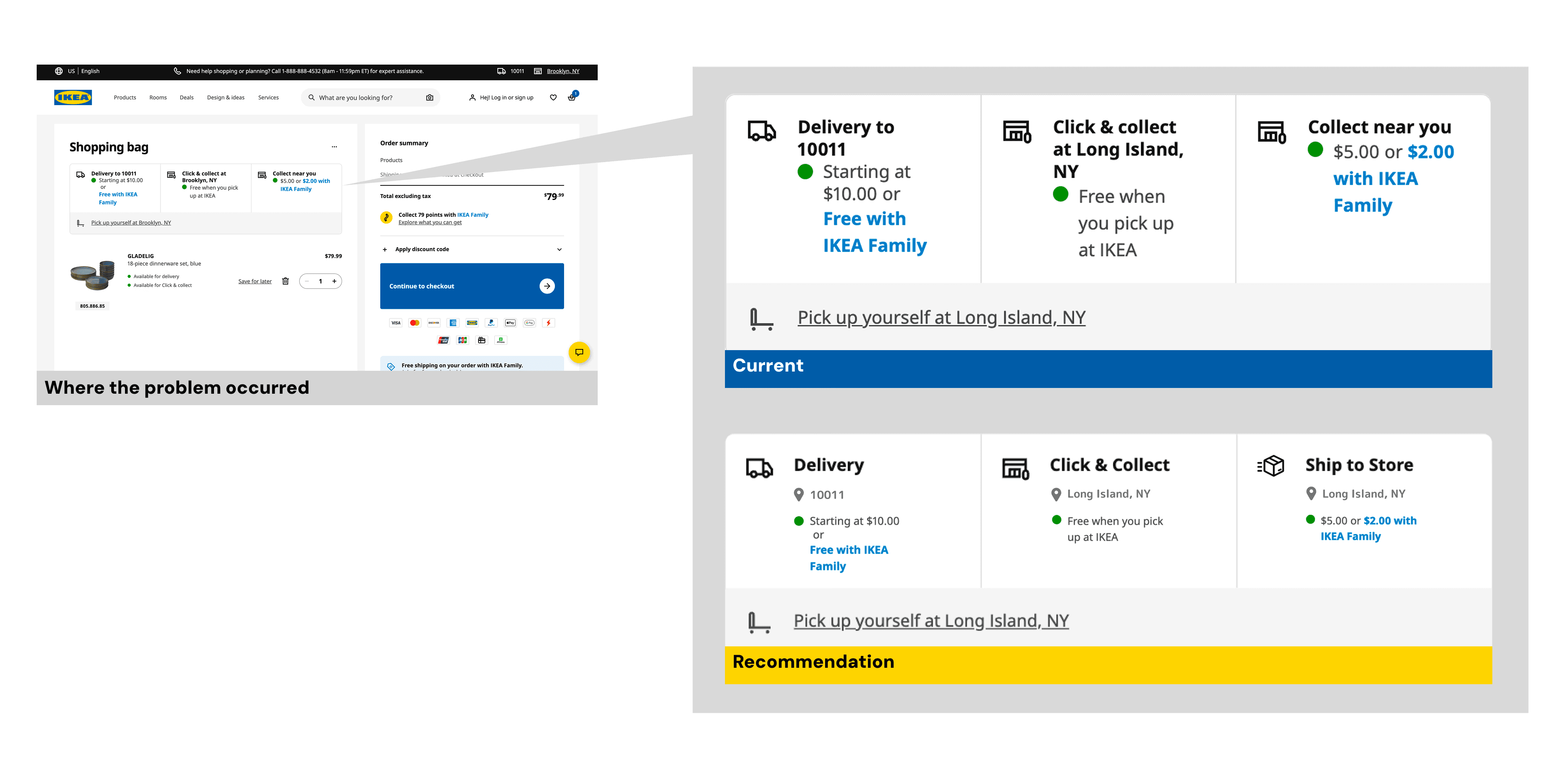
The website assumes prior knowledge of how the fulfillment options work. Without additional context, users are left to guess what distinguishes one option from another, or whether the choice even matters. This ambiguity at the most critical stage of the user journey can lead to decision paralysis, cart abandonment, selection errors, and increased support inquiries.
Key insight
Checkout should be a moment of clarity and confidence, not uncertainty. Friction at this stage has a disproportionately high impact on conversion rates and brand perception. This was the only issue in our evaluation rated as a catastrophe.
RECOMMENDATION 1
Differentiate Fulfillment Terminology and Icons
Heuristics Violated:
To reduce confusion and increase confidence at checkout, each fulfillment option should use distinct, action-oriented language paired with visually differentiated icons. The recommended labels communicate the key difference: where the order ships and how the user retrieves it.
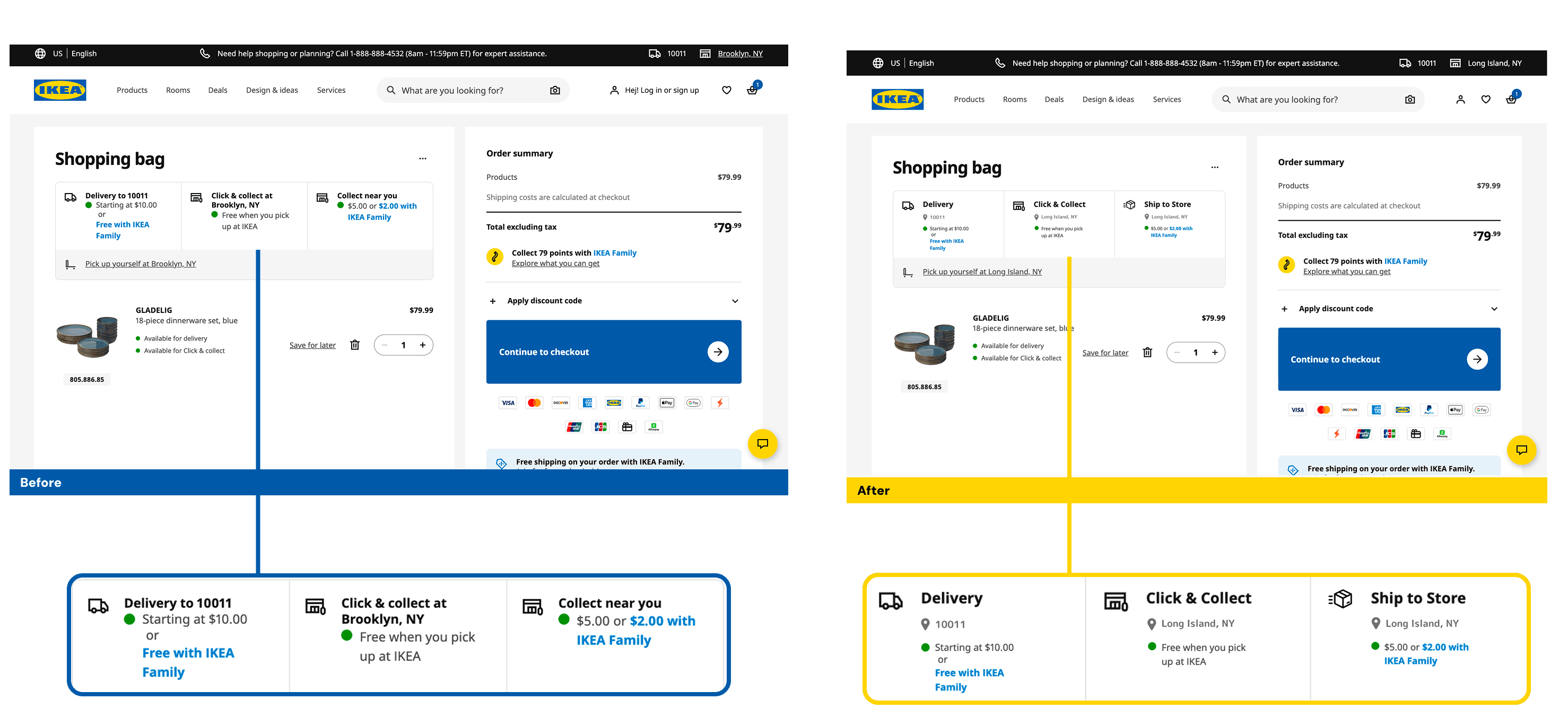
Before and after: updated fulfillment option terminology and icons to reduce ambiguity and communicate meaningful differences between delivery and pickup methods.
The Solution: Reframing 'Pick up yourself
The "Pick up yourself" link compounds confusion by echoing the pickup language used in the fulfillment options above. It ends up sounding like another variation of in-store pickup rather than what it actually is: browsing the store to find and purchase the item on your own, without placing an online order.
By reframing the language around the action the user will take ("find the item") rather than the fulfillment-oriented "pick up," the updated label distinguishes this option as a self-serve, in-store experience separate from the online ordering flow.
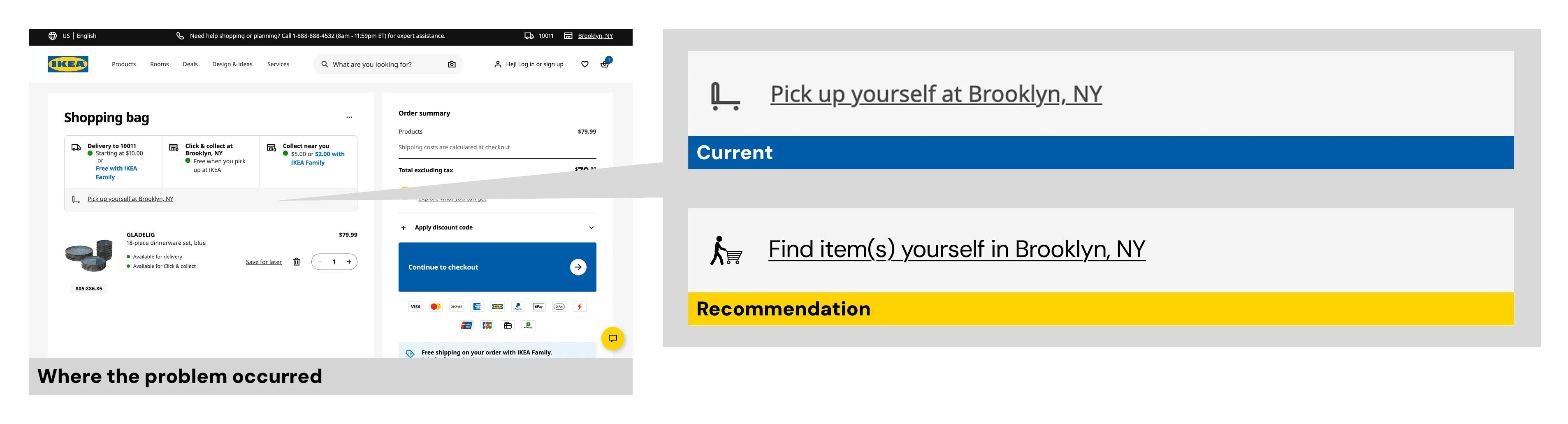
Before and after: "Pick up yourself" relabeled to "Find the item yourself in Brooklyn, NY" to distinguish the in-store self-serve experience from online fulfillment options.
RECOMMENDATION 2
Improve Information Transparency Through Consistent Interaction and Tooltips
Heuristics Violated:
Even with clearer terminology, detailed information about each fulfillment method is still lacking at the point of decision. The current system behavior is inconsistent: clicking "Delivery" opens a side panel with clear descriptions, but "Click & Collect" only shows a store selector without explanation, and "Collect near you" isn't clickable at all.
Users see options but can't evaluate what they mean or which is best for them. Descriptions exist on the Customer Service page, but forcing users to leave the shopping bag to find definitions increases cognitive load and interrupts the journey.
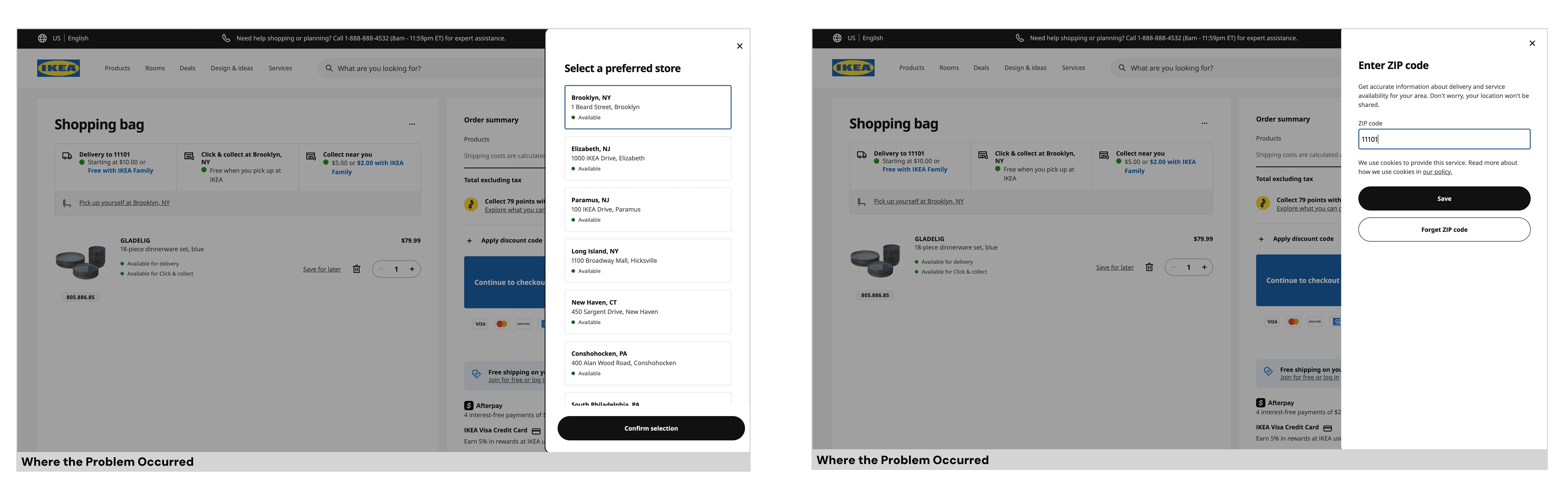
The current fulfillment interface shows inconsistent interactions and missing descriptions: 'Delivery' provides context, while 'Click & Collect' offers only a store list with no explanation of the service.
The Solution: Layered Information Access
All fulfillment options should be clickable and trigger a consistent side panel with a detailed service description at the top. Additionally, an (i) icon next to each option provides a tooltip with a short hover description -> a progressive disclosure pattern that helps new users without slowing down experienced ones.
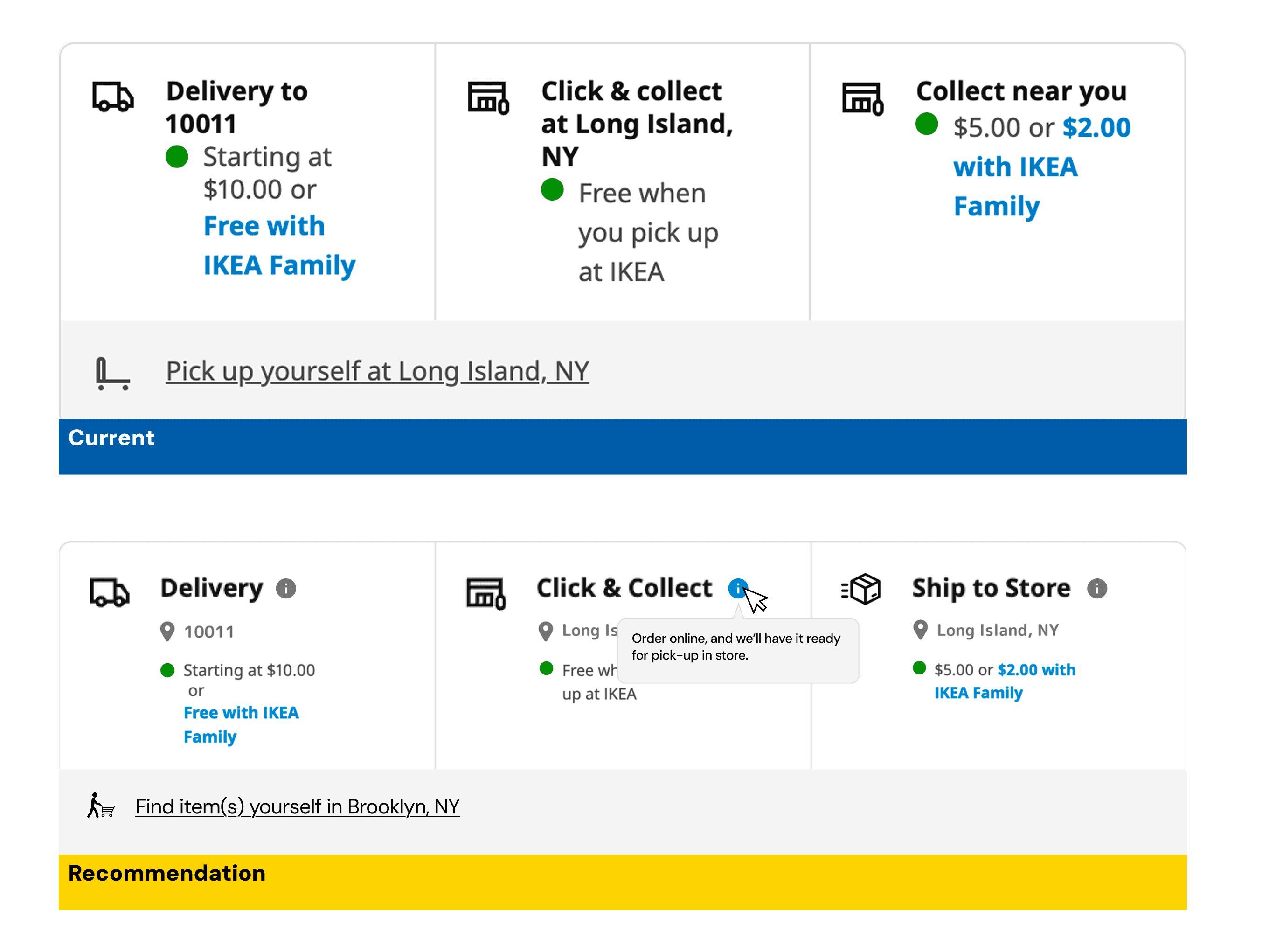
Updated fulfillment options with (i) tooltip icons providing quick hover descriptions, along with distinct labels and icons for each method.
RECOMMENDATION 3
Harmonize the Cart-As-Checklist Experience
Heuristics Violated:
When users click the "Pick up" checkbox next to "Where to find" in the store pickup flow, the system prompts them to remove items from their cart, which creates confusion. Users can't understand why the system wants them to delete items they intend to buy.
IKEA intends for the digital cart to function as a dual-purpose shopping list: users add items online, use the cart to locate them in-store, then manually remove items from the digital cart once they've placed them in their physical trolley. But this logic is never communicated to the user, creating a fundamental mental model mismatch. Users expect "Cart = Final Purchase," not "Cart = Navigation Checklist."
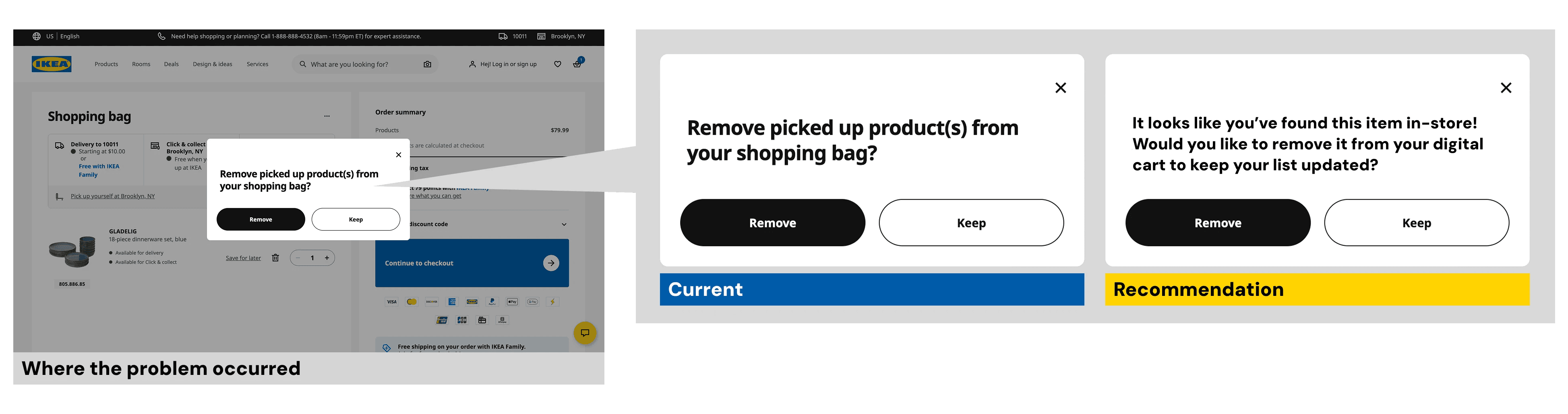
Current versus recommended cart removal dialog — replacing a system command with a contextual, conversational prompt.
The Solution: Humanize the Prompt
Instead of the current technical prompt ("Remove picked up product(s) from your shopping bag?"), the system should use conversational language that acknowledges the user's physical progress in the store: "It looks like you've found this item in-store! Would you like to remove it from your digital cart to keep your list updated?"
By reframing the prompt from a system command to a contextual question, this solution bridges the Gulf of Evaluation, turning a forced deletion into a conscious choice.
OUTCOMES
Closing the Gap Between System Logic and User Expectations
Decision-making becomes faster and more confident
Checkout friction is reduced, supporting conversion
The IKEA brand experience is strengthened through clarity
What I’d Do Next
Map the full end-to-end fulfillment journey
Explore opportunities for proactive guidance
REFLECTION
What I learned
This project reinforced that usability issues often stem not from broken functionality but from a disconnect between how a system is built and how people think. IKEA's fulfillment options all work, the problem is that users can't tell them apart. The fix isn't adding more features; it's making existing ones legible.
Organizing a group of ten evaluators with my team also deepened my understanding of how to synthesize diverse perspectives into actionable recommendations. The evaluators' findings varied in severity and framing, but the underlying patterns (e.g., overlapping language, missing context, inconsistent interactions) all pointed to the same core issue: the system assumes too much about what users already know.
This evaluation sharpened my approach to UX writing and information architecture: language is just as impactful as the interface. When labels fail to communicate what services actually offer, no amount of visual polish can compensate.